Physical Address
304 North Cardinal St.
Dorchester Center, MA 02124
Physical Address
304 North Cardinal St.
Dorchester Center, MA 02124

You’ve seen those disaster movies where everyone flees the city—but what if you can’t? When evacuation isn’t an option, your apartment becomes your survival bunker. Whether it’s civil unrest, pandemic lockdowns, or infrastructure collapse, urban survival requires a completely different mindset than traditional “bug out” strategies. Your 800 square feet might feel limiting now, but with proper preparation, those same walls that trap you will become your greatest asset in weathering whatever chaos unfolds outside your door.
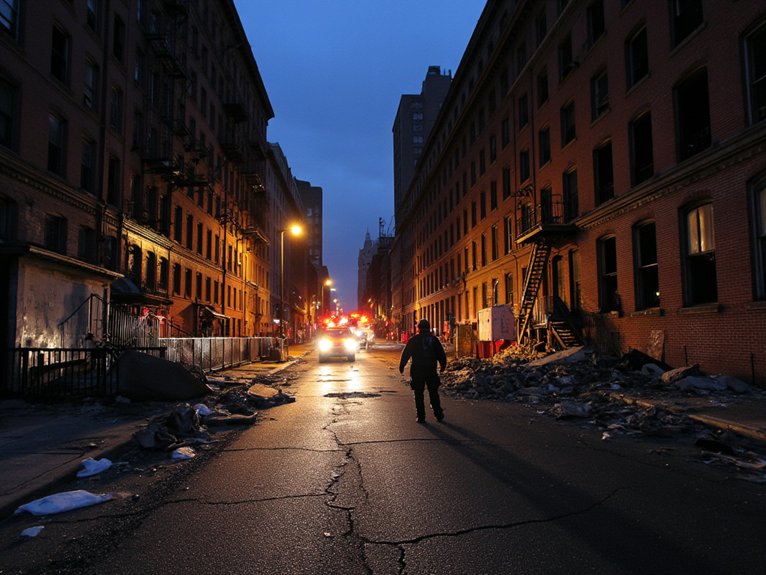
How much have you really looked at your living space through the lens of survival? That corner apartment with floor-to-ceiling windows might dazzle guests, but it’s a thermal nightmare during power outages. Your assessment should start with building materials—concrete structures offer better insulation and fire resistance than wood frames, which matter when HVAC systems fail.
Don’t overlook urban flora either. That decorative rooftop garden? It’s potentially your food source. Those shade trees? Natural cooling. You’re not just evaluating square footage; you’re mapping resource zones within your concrete jungle.
Take inventory of spaces that serve dual purposes: bathtubs store water, closets become secure storage. Remember, your survival potential isn’t determined by the size of your space, but by how strategically you’ve analyzed it.
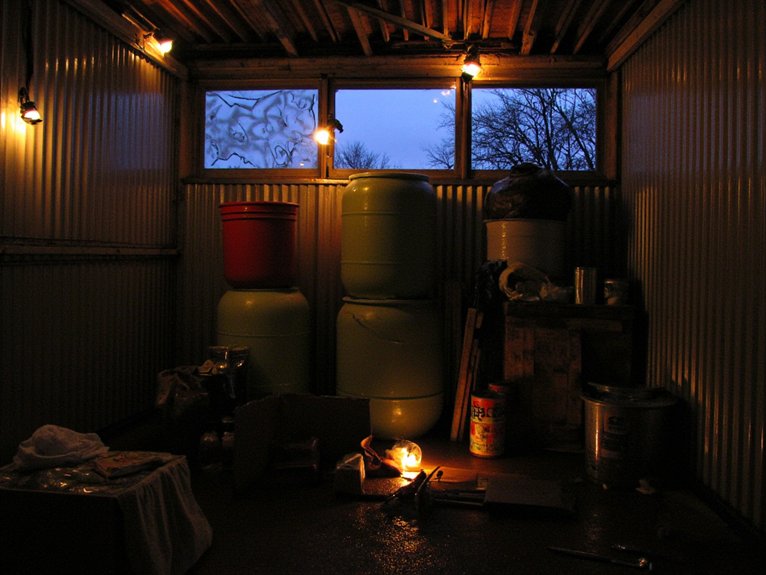
While evaluating your space reveals structural advantages, water remains your most pressing urban survival requirement. You’ll need approximately one gallon per person daily, with a minimum two-week supply stored in your shelter-in-place location.
Don’t rely solely on bottled water. Consider rainwater harvesting through simple window collection systems using clean tarps that direct precipitation into sanitized containers. Even in apartments, you can position collectors on fire escapes or balconies.
For water purification, keep multiple redundant methods ready: unscented bleach (8 drops per gallon), water purification tablets, a quality filter, and the ability to boil water using alternative heat sources. Remember, your bathtub can store 80+ gallons if lined with a clean shower curtain before filling during the initial disaster warning. The water heater in your building is another overlooked reservoir—just turn off the inlet valve first!
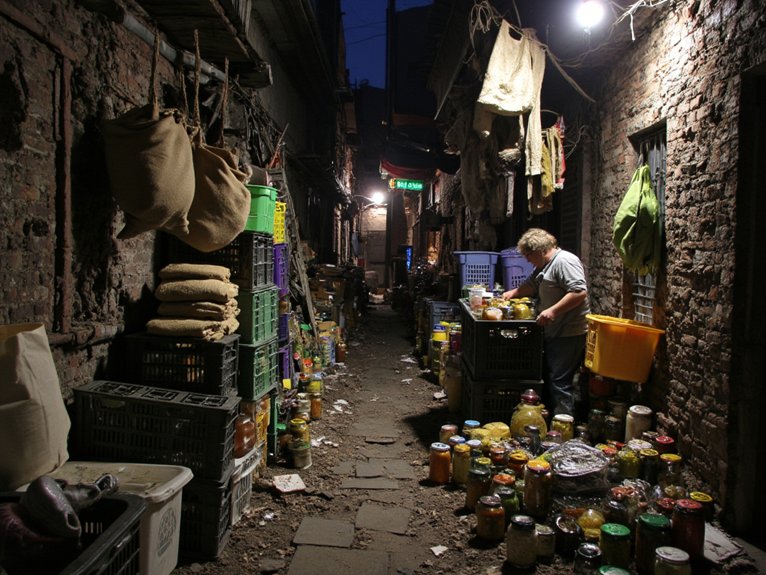
When living in a small urban apartment, you’ll need to get creative with food storage by utilizing vertical space with wall-mounted shelving, under-bed containers, or vacuum-sealed bags that compress bulky items. You can maximize the lifespan of your emergency food supply through proper rotation (first in, first out), oxygen absorbers for dry goods, and mylar bags that block light and moisture. Remember that your urban food cache doesn’t need to rival a doomsday bunker—even a two-week supply strategically hidden throughout your living space can make the difference between comfort and crisis during an emergency.
Living in cramped urban apartments doesn’t mean you’ll need to sacrifice emergency food preparedness. With strategic thinking, every square inch becomes valuable real estate for your survival supplies. Compact furniture with hidden compartments—ottomans, coffee tables, bed frames with drawers—can store weeks of provisions while maintaining your living space’s functionality. Vertical storage is your secret weapon; install ceiling-to-floor shelving systems in closets or behind doors for maximum capacity.
For ideal urban food storage, consider:
Urban food stockpiles are only as good as their longevity. When you’re confined to an apartment during a crisis, those expiration dates suddenly become your countdown clock. Oxygen absorbers and vacuum sealing can transform your pantry’s timeline—I’ve personally extended pasta’s shelf life from 2 years to 5+ with proper sealing techniques.
Temperature control is essential. If you’ve got solar power, consider a small energy-efficient freezer—it’s worth the investment. For dry goods, cool, dark spaces extend viability dramatically. Remember, your bathroom cabinet (fluctuating humidity) is food storage’s worst enemy.
Urban agriculture provides perpetual fresh alternatives to preserved foods. Sprouting seeds require minimal space but deliver maximum nutritional punch when your canned goods start looking questionable. Trust me, you’ll appreciate that living food when you’re six months into rationing!
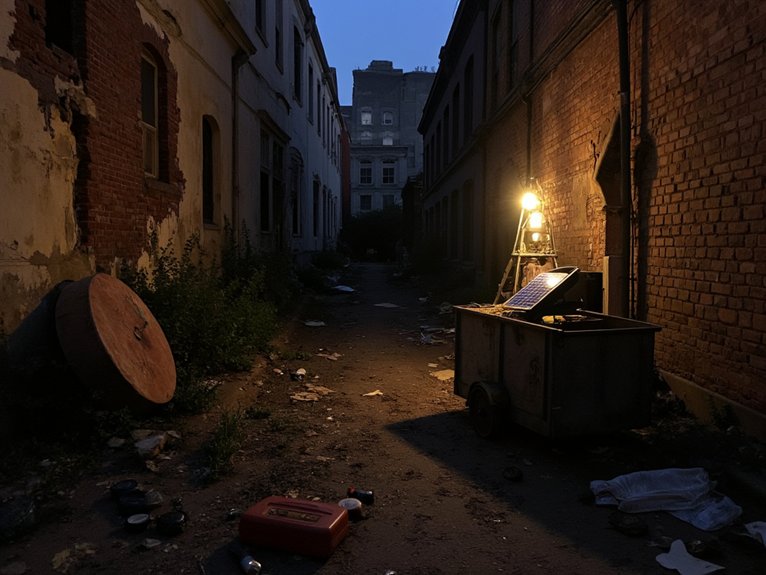
As disruptions to our electrical infrastructure become increasingly common, you’ll need reliable alternatives to keep essential devices powered during grid failures. Renewable energy options like portable solar panels offer sustainable power backup without fuel concerns. I’ve relied on a 100-watt folding panel during three extended outages—it’s surprisingly efficient even on cloudy days.
Consider these critical power options:
Remember: even modest power alternatives beat sitting in the dark. Start small with device chargers, then expand your capacity as budget allows.
When your apartment or home becomes your fortress during urban disasters, you’ll need more than just hope to keep intruders at bay. Your first line of defense should focus on hardening entry points—reinforcing doors with additional locks, door jammers, and strike plates, while securing windows with shatterproof film and improvised barriers like bookshelves or furniture. In apartment settings, tactical positioning becomes essential: establish clear fields of view, identify multiple escape routes, and create defensive zones that funnel potential threats through predictable pathways.
How secure is your front door right now? If you’re like most urban dwellers, it’s probably more vulnerable than you realize. While you might excel at urban gardening on your balcony or steering through public transportation during normal times, your entry points need serious reinforcement before disaster strikes.
Hardening your entries doesn’t need to break the bank:
These simple upgrades transform your entryway from an invitation to a proper deterrent.
Despite having a reinforced door and window security film, you’ll need additional layers of protection during a serious urban emergency. Makeshift barricades using furniture can transform your apartment into a defensive position that buys critical time during a break-in attempt. Stack bookshelves against walls adjacent to doors, then place heavy furniture—dressers, tables turned sideways—directly behind entrance points.
For window approaches, create standoff barriers using layered obstacles. Remember, defensive positioning isn’t just about barricades—it’s about controlling sight lines and creating chokepoints. A couch on its side provides both concealment and cover (yes, there’s a difference—one hides you, one stops bullets).
I’ve found that interlocking furniture creates stronger resistance than single pieces. Use zip ties or duct tape to secure items together, creating a unified barrier that’s harder to dismantle.
Smart tactical positioning inside your apartment can mean the difference between vulnerability and relative safety during a crisis. I’ve learned through years of urban preparedness that understanding your space strategically isn’t just smart—it’s essential. Your apartment layout offers both challenges and advantages for defensive positioning.
When disaster strikes urban areas, you’ll quickly discover that modern communication networks aren’t as resilient as you might think. Cell towers fail, internet goes down, and you’re suddenly thrust back to pre-digital times. This is when alternative systems prove invaluable.
Ham radio is your best friend in these scenarios. Unlike commercial networks, it doesn’t rely on vulnerable infrastructure. With a modest investment in equipment and a license, you’re connected to a global community of operators. I’ve used mine during three blackouts with remarkable success.
Satellite phones offer another solution, bypassing ground-based systems entirely. They’re expensive—I won’t sugarcoat that—but they work when nothing else does. If you can’t justify the cost, consider forming a neighborhood group to share one. Remember: in disasters, information becomes as valuable as water.
Communication systems may fail during disasters, but your bodily functions certainly won’t. When you’re confined to your apartment during extended lockdowns, waste disposal becomes a critical challenge. I’ve learned this firsthand after a week-long power outage in my city. You’ll need to improvise sanitation systems that prevent disease while maintaining dignity.
For effective personal hygiene and waste management:
Because hospitals quickly become overwhelmed or inaccessible during urban disasters, you’ll need to handle medical situations independently for days or even weeks. Mastering first aid fundamentals isn’t optional—it’s essential. Take a proper course now, not during the crisis when YouTube tutorials might be unavailable.
Your emergency medical kits should include more than just bandages. Stock antibiotics (if legally obtained), prescription medications (3-month supply minimum), wound closure alternatives (butterfly strips, surgical glue), and trauma supplies like tourniquets and pressure bandages. Trust me, the day you need QuikClot is not the day to wish you’d bought some.
While your physical safety takes priority during urban disasters, your psychological resilience ultimately determines survival success. Extended confinement in your apartment during crisis situations tests your mental resilience in ways you can’t prepare for physically. I’ve seen strong people crack under the pressure of uncertainty while those with emotional preparedness thrived.
Implement these strategies to maintain sanity:
Urban survival isn’t just about supplies—it’s about protecting your mind.
Your mental fortitude provides the foundation for survival, but no urban dweller exists as an island during disasters. The neighborhood around you holds untapped potential – both in people and resources.
Start by establishing neighborhood watches that function beyond crime prevention; these networks can coordinate supply sharing and security during emergencies. I’ve seen watch groups transform into lifesaving teams during blackouts. Community drills, while awkward at first (trust me, my first one involved three false alarms and one confused pizza delivery guy), build muscle memory for collective action.
Map your community’s hidden assets: the retired nurse three doors down, the carpenter with a workshop, the apartment with the massive rainwater collection system. These connections often prove more valuable than extra canned goods when infrastructure fails.