Physical Address
304 North Cardinal St.
Dorchester Center, MA 02124
Physical Address
304 North Cardinal St.
Dorchester Center, MA 02124
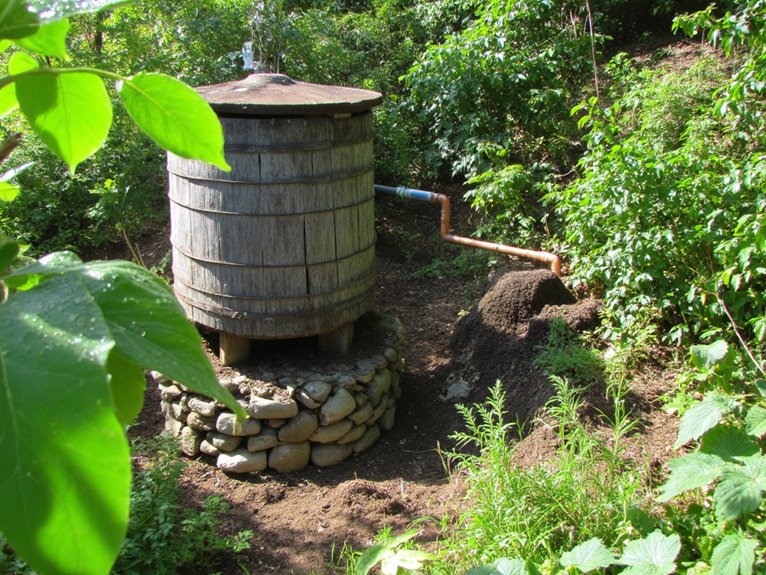
You’ve probably considered rainwater harvesting for your off-grid setup, but what happens during those inevitable dry spells? While rain barrels are a good start, they’re just the tip of the iceberg. From tapping into groundwater with solar pumps to capturing moisture from the air itself, alternative water systems can transform your self-sufficiency game. I’ve tested several approaches that don’t require rainfall, and the results might surprise you. The real question isn’t if you can live without municipal water—it’s which combination of methods works best for your situation.

When you’re living off the grid, accessing clean water becomes your top priority, and groundwater wells with solar-powered pumps offer one of the most reliable solutions. Unlike rainwater collection, wells tap into consistent underground aquifers that flow year-round, regardless of weather conditions.
Your well depth matters tremendously—shallow wells (under 50 feet) require less pumping power but risk contamination, while deeper wells provide purer water but demand robust solar arrays. You’ll need about 200 watts of solar capacity per 100 feet of well depth as a starting point.
Don’t skimp on pump maintenance! I learned this lesson the hard way after three days without water during a system failure. Schedule quarterly inspections to check wiring connections, clean solar panels, and test water quality. A well-maintained solar pump system can operate reliably for 15+ years with minimal intervention.

Atmospheric water harvesting might sound like science fiction, but three remarkable technologies now make it possible to pull drinking water directly from thin air. Dew harvesting systems use radiative cooling to condense moisture on specially designed surfaces, while fog collection employs mesh nets to capture water droplets in humid environments. You’ll be amazed at how these systems can function without external power sources in the right conditions.
I’ve tested several models myself and can confirm they’re game-changers for remote locations.

Locating a natural spring on your property’s a bit like finding buried treasure—you’ll need to look for telltale signs like lush vegetation patches, consistently damp ground, or water seeping from hillsides during dry periods. Once you’ve found your liquid gold, protecting it from contamination becomes your top priority, requiring steps like constructing a proper spring box, diverting surface runoff, and maintaining a buffer zone free from livestock or septic systems. You’d be surprised how quickly a pristine spring can turn problematic without these safeguards, especially after that time my neighbor’s perfectly clear spring turned murky brown following his decision to create a “convenient” cattle path nearby.
Finding natural springs on your property isn’t just a matter of luck—it’s a skillful blend of observation, geological knowledge, and sometimes a bit of traditional wisdom. When conducting spring mapping, you’ll want to look for telltale signs that water is moving underground toward the surface.
You’ll need patience and persistence. Sometimes the most reliable springs aren’t obvious at first glance, but they’ll reward you with consistent water when properly developed.
Once you’ve located a promising spring on your property, protecting it from contamination becomes your top priority for ensuring a safe, reliable water source. Start by constructing a spring box—essentially a sealed concrete or plastic container that captures water at its emergence point. This creates a barrier against surface contaminants, wildlife, and debris.
Don’t skip regular microbial testing; what looks crystal clear can harbor invisible pathogens. I’ve seen pristine-looking springs fail coliform tests spectacularly! Chemical treatment with ultraviolet light or chlorination may be necessary depending on your test results.
Install an uphill diversion trench to redirect surface runoff away from your spring. Remember, your spring’s protection zone extends beyond what you see—fence off at least a 100-foot radius to prevent livestock intrusion, and avoid using fertilizers or pesticides nearby. Your future self will thank you!

While traditional water systems send used shower, sink, and laundry water down the drain, greywater recycling presents a sustainable alternative that’s gaining popularity among homesteaders. You’ll find that implementing a simple greywater treatment system can reduce your freshwater usage by up to 50% while providing eco-friendly disposal options for your homestead.

Across the spectrum of off-grid water solutions, micro-scale filtration methods stand out as your first line of defense against waterborne contaminants. When you’re living off the grid, you’ll need reliable systems that don’t require electricity or complicated infrastructure.
| Filtration Type | Contaminants Removed | Emotional Impact |
|---|---|---|
| Ceramic Filters | Bacteria, Protozoa | Peace of mind when drinking |
| Activated Carbon | Chemicals, Odors | Relief from worry about toxins |
| Biofiltration media | Organic Matter | Connection to natural processes |
| Membrane Filters | Viruses, Bacteria | Freedom from dependence on utilities |
| Sand/Gravel Layers | Sediment, Particulates | Satisfaction in simplicity |
I’ve found that combining a 0.2-micron filtration membrane with natural biofiltration media creates a robust system that’s both effective and sustainable. You’ll appreciate how these methods mimic nature’s own purification processes.

When seasonal fluctuations affect your water availability, you’ll need storage solutions that adapt to changing conditions. I’ve learned that strategic planning makes all the difference between abundance and scarcity. Your rainwater harvesting system should connect to diverse storage options that accommodate seasonal patterns.

Beyond storing water for everyday use, you’ll eventually face situations where water simply isn’t available. That’s when water-free adaptations become essential to your off-grid lifestyle. People have implemented these strategies at their homesteads with surprising success.
| Adaptation | Water Conservation | Implementation Difficulty |
|---|---|---|
| Dry toilets | Saves 20-40 gallons daily | Moderate |
| Sponge bathing | 90% reduction over showers | Easy |
| Waterless cooking | Uses steam circulation | Challenging |
| Xeriscaping | Supports aquifer recharge | Moderate |
You’ll find these methods aren’t just emergency measures—they’re practical lifestyle shifts that’ll dramatically reduce your dependency on traditional water sources. The xeriscaping approach is particularly effective; it channels what little precipitation you receive directly into groundwater, supporting natural aquifer recharge while creating a self-sustaining landscape around your dwelling.
You’ll need to check local permit requirements for off-grid water systems. Legal considerations typically include well permits, water rights, and health department approvals for your specific location.
You’ll typically spend $5,000-$15,000 for a complete system. Cost estimation varies based on your property size, while equipment selection impacts expenses—well drilling alone ranges from $1,500-$12,000.
Yes, they’ll work in freezing climates if you implement proper freezing protection. You’ll need pipe insulation, heat tape, buried lines, and potentially a heated pump house to prevent damage.
You’ll need water testing kits that check for bacteria, chemicals, and heavy metals. Test regularly and identify potential pollution sources near your water collection points to guarantee safety.
When your system fails, you’ll need emergency storage containers and portable filtration options. Keep bottled water, water bricks, hand pumps, and gravity filters ready for immediate use during disruptions.