Physical Address
304 North Cardinal St.
Dorchester Center, MA 02124
Physical Address
304 North Cardinal St.
Dorchester Center, MA 02124
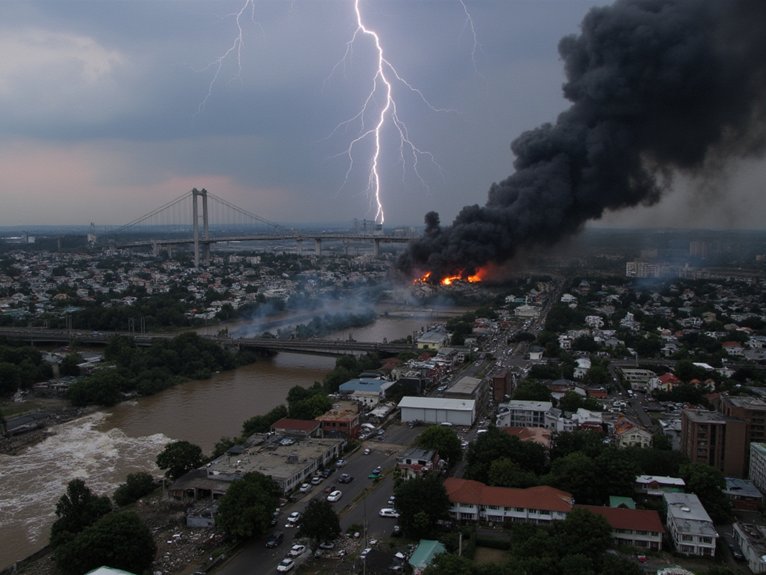
You’ve probably noticed how problems rarely travel alone. Consider the last major power outage you experienced—it wasn’t just lights out, was it? Communications failed, traffic snarled, and food spoiled in your fridge. That’s a cascading disaster in miniature. When scaled up to regional or global levels, these chain reactions become truly terrifying, as one system’s failure triggers another’s collapse like falling dominoes. What happens when our carefully engineered safeguards face multiple simultaneous threats they weren’t designed to handle?

When disaster events unfold, they rarely occur in isolation. You’re witnessing a complex domino effect where one failure triggers another, creating a cascade of consequences that can overwhelm response systems. Think of the 2011 Fukushima disaster – earthquake leads to tsunami, which destroys power systems, leading to nuclear meltdown.
These chains reveal interconnected vulnerabilities in our infrastructure, economy, and social systems. You’ll notice how quickly seemingly unrelated sectors can affect each other: power outages disrupt water treatment, which compromises healthcare delivery.
The systemic feedbacks are particularly troublesome. When hospitals lose power, they can’t treat injured people, who then can’t return to work, which affects economic recovery. It’s like watching a well-orchestrated tragedy where each player unwittingly cues the next catastrophe – except you’re in the audience and the theater’s on fire.

The pages of history offer sobering lessons in how cascading failures have brought entire civilizations to their knees. Remember the 2008 financial crisis? What began as a subprime mortgage problem quickly triggered economic shocks that rippled across global markets. You couldn’t escape the domino effect.
The 1986 Chernobyl disaster presents an even more terrifying example. A safety test gone wrong—combined with design flaws and operator errors—led to policy failures that initially concealed the catastrophe. The Soviet government’s delayed response magnified the health impacts exponentially.
You’ll notice a pattern in these historical collapses: systems that seem robust can harbor hidden vulnerabilities. When Hurricane Katrina struck New Orleans in 2005, it wasn’t just the storm but the sequential failure of levees, emergency services, and governance that transformed a natural disaster into a humanitarian crisis.

Unlike the disasters we’ve just examined, climate change doesn’t merely trigger isolated catastrophes—it systematically amplifies existing hazards while creating entirely new ones. You’re witnessing a process where one climate event kickstarts another, creating dangerous climate feedbacks that accelerate faster than predicted.
Consider what happens when Arctic ice melts: dark ocean water absorbs more heat than reflective ice did, warming waters further. That’s an environmental tipping point you don’t want to cross. When these systems shift, they don’t politely return to normal.
Your hometown’s “hundred-year flood” might now arrive every decade. The wildfire season you grew up with? It’s expanded by months. What makes climate change uniquely threatening isn’t just its global reach—it’s how it transforms predictable hazards into cascading crises that overwhelm our response systems simultaneously.

Modern society’s critical infrastructure systems function like a vast, interconnected neural network where damage to one system rapidly cascades to others. When power fails, you’ll quickly notice how it affects water pumps, hospital services, and communications. It’s like watching dominoes fall, but with far more serious consequences.
You’ve probably experienced this firsthand during a major storm—no electricity means no internet, limited phone service, and possibly no water pressure. This is why interdependency mapping has become critical for disaster management professionals. They’re essentially creating relationship diagrams between systems to predict failure chains.
Resilience planning now focuses on these connections rather than isolated systems. You can’t just harden the electrical grid if water treatment facilities don’t have backup power. It’s a complex puzzle that requires holistic thinking.

When major disasters strike, public health systems often become overwhelmed within hours, creating a dangerous snowball effect that compounds the original emergency. You’ll notice how hospitals quickly reach capacity, medication supplies dwindle, and healthcare workers face exhaustion. It’s a perfect storm.
Your community’s pandemic preparedness plays a vital role here. Areas with robust emergency protocols fare better, while those without proper planning see devastating ripple effects. Trust me, I’ve witnessed this firsthand.
Don’t overlook the mental health cascade that follows. As physical systems crumble, psychological support vanishes precisely when it’s needed most. You’d be surprised how quickly anxiety and depression rates spike after disasters. The invisible wounds often outlast the physical damage, creating a secondary crisis that may persist for years.

The technical failures we’ve discussed represent only the visible portion of disaster cascades, while the social dimensions often remain hidden until they erupt. When disasters strike, you’ll notice how quickly panic spreads—this is social contagion at work. Remember Hurricane Katrina? The initial flooding was awful, but the behavioral amplification that followed—looting, mistrust, and information chaos—created a secondary crisis.
You’re witnessing these patterns more frequently now. When society loses trust in authorities during a disaster, the ripple effects can exceed the original catastrophe. A power outage becomes a security threat; a flood transforms into a governmental crisis. These social cascades aren’t merely reactions; they’re predictable phenomena that emergency managers must anticipate. Unlike broken levees, human behaviors can’t be fixed with engineering—they require understanding our collective psychology.

Despite impressive advances in computing power, predicting where and how disaster cascades will unfold remains fiendishly difficult. You’re fundamentally trying to model chaos—a hurricane knocks out power, which disables water treatment, which leads to disease outbreaks. It’s like forecasting a game of disaster dominoes while blindfolded.
Modern risk assessment tools increasingly incorporate these interdependencies, but they’re far from perfect. When you run simulation modeling on potential scenarios, you’ll notice how small variations in initial conditions produce wildly different outcomes. Remember the 2011 Tohoku earthquake? Experts had modeled tsunami risks but underestimated the nuclear complications. The best predictive frameworks now combine technical systems with human behavior patterns—because let’s face it, people rarely follow the rational paths our neat models expect them to.

Building resilience against cascading disasters requires a fundamental shift in how you’ll approach emergency preparedness systems. You can’t just plan for isolated events anymore. I’ve seen communities transformed when they embrace integrated planning strategies.
| Resilience Level | Community Engagement Approach | Results |
|---|---|---|
| Basic | Annual drills, minimal training | Limited response to cascades |
| Intermediate | Cross-sector coordination, quarterly exercises | Can handle 2-3 linked events |
| Advanced | Continuous training, inclusive planning | Withstands complex cascades |
Financial markets respond with heightened market volatility during disasters. You’ll notice investors fleeing to safe assets as investor behavior shifts toward risk aversion until uncertainty subsides and recovery begins.
You’ll experience more prolonged psychological trauma in cascading disasters than single events, challenging your emotional resilience as multiple crises overwhelm coping mechanisms and recovery efforts simultaneously.
You’ll find indigenous knowledge systems utilized traditional mitigation strategies through intergenerational learning. Their indigenous resilience incorporated landscape management, seasonal preparation, and community cooperation patterns that anticipated interconnected hazards.
You’ll find AI can drastically improve cascade detection through predictive analytics that identify emerging patterns. When integrated with sensor networks, you’re able to receive early warnings before secondary disasters unfold.
You’ll notice policy adjustments and coverage limitations becoming more common as insurers respond to cascading risks. Your standard policy might exclude secondary damages unless specifically added.