Physical Address
304 North Cardinal St.
Dorchester Center, MA 02124
Physical Address
304 North Cardinal St.
Dorchester Center, MA 02124
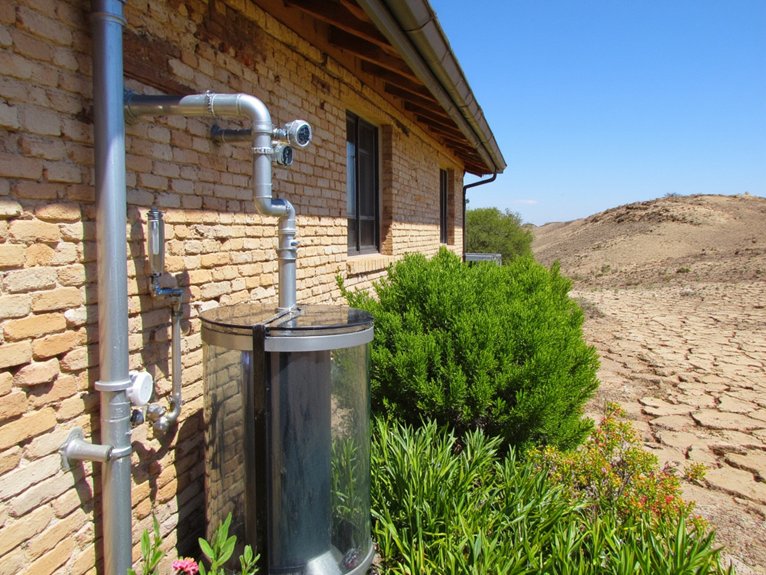
You’ve probably watched water restrictions tighten during droughts and wondered if there’s a better way. There is. While traditional rainwater collection falls short when skies stay clear, innovative systems now capture moisture from seemingly impossible sources—even bone-dry air. From fog catchers that transform coastal mist into drinking water to atmospheric generators that extract humidity overnight, these technologies aren’t just theoretical. They’re working today in some of Earth’s harshest environments. What if you could implement one in your own community?

Although you might not realize it, the air around you contains substantial amounts of moisture that can be extracted and converted into clean drinking water. Atmospheric water generators (AWGs) do exactly this, using condensation technology that mimics nature’s own processes.
Unlike traditional urban rain harvesting systems that rely on precipitation, AWGs work even in drought conditions. They’re particularly valuable in regions where underground aquifer recharge has slowed due to climate change. You’ll find these devices range from portable units that produce a few liters daily to industrial-scale operations generating thousands.
The technology isn’t new—your refrigerator uses similar principles—but recent innovations have made AWGs more energy-efficient. While they won’t replace conventional water sources entirely, they’re a promising complement to your drought-preparedness toolkit. Sometimes the solution is literally in the air!

A simple mesh net stretched across the right landscape can transform morning mist into life-sustaining water. You’ve probably seen urban rain harvesting systems with downspouts and barrels, but fog catchers work differently. They’re particularly effective where fog rolls in regularly but rainfall is scarce.
| Location | Yield (L/day) | Installation Cost | Maintenance | Sustainability |
|---|---|---|---|---|
| Coastal hills | 200-500 | Medium | Quarterly | Excellent |
| Mountain ridges | 100-300 | Low | Monthly | Very good |
| Desert outskirts | 50-150 | Medium | Bi-weekly | Good |
| Urban periphery | 30-100 | High | Weekly | Moderate |
| Inland valleys | 10-50 | Low | Monthly | Fair |
Unlike underground aquifer recharge systems that take years, you’ll collect water immediately. The nets aren’t pretty, but they’re remarkably effective when you’re facing drought conditions.

When surface water proves scarce, you’ll find impressive reserves hiding just beneath your feet. Deep soil moisture collection systems tap into this hidden resource, allowing you to harvest water where others see only dust and dryness. These systems use advanced soil moisture sensors to identify pockets of water retention at depths of 3-10 feet—zones that remain damp long after surface soils have dried out.
You’ll need specialized equipment to access this moisture, but the payoff is substantial. Deep root irrigation techniques, originally developed for drought-resistant agriculture, have been adapted for household water collection. By creating a network of perforated pipes at strategic depths, you’re fundamentally mimicking what baobab trees do naturally in arid climates. The best part? Unlike rainwater harvesting, these systems work year-round, even during the most persistent droughts.

You’ll find that lightweight mesh collectors represent one of the most efficient methods for capturing overnight dew, often collecting several liters of water per square meter in humid environments. These collectors work by providing a cool surface where water vapor can condense, much like morning dew forms on spider webs or grass. Biomimetic surface technology—inspired by the Namib Desert beetle’s water-collecting shell—takes this concept further by incorporating microscopic bumps and channels that direct water droplets toward collection points, improving yield by up to 40% compared to traditional mesh designs.
Glancing up at dawn on a fog-laden morning, you’ll notice how nature quietly collects water on every available surface—a phenomenon we’ve ingeniously replicated with lightweight mesh collectors. These remarkable structures, often made of polyethylene or stainless steel meshes, can extract up to 10 liters per square meter daily from seemingly dry air.
You’re probably familiar with urban rain harvesting systems that collect precipitation, but mesh collectors work even when the clouds withhold their bounty. Unlike traditional water conservation techniques that store existing water, these nets actually create new supply. They’re surprisingly affordable too—you can build a basic 1m² collector for under $30. The mesh’s hydrophilic coating attracts moisture particles, which coalesce into droplets heavy enough to slide down into collection troughs. Simple physics, extraordinary results.
Nature’s finest water collection mechanisms inspire today’s most efficient dew harvesting technologies. You’ll notice how Namib Desert beetles and spider webs have influenced designs that capture moisture from thin air. These systems complement traditional rainwater harvesting with overnight collection, even during droughts.
| Surface Type | Water Yield | Best Application |
|---|---|---|
| Beetle-inspired | 1-3L/m²/night | Urban farming |
| Spider silk mimetic | 2-4L/m²/night | Residential use |
| Cactus-patterned | 3-5L/m²/night | Commercial systems |
You’re looking at technology that’s revolutionizing water collection. The hydrophobic-hydrophilic patterned surfaces create condensation points where water droplets form and channel toward collection points. They’re quiet, require no electricity, and work while you sleep. Isn’t it remarkable how nature’s solutions are hiding in plain sight?

Why wait for rain when you’re already generating gallons of reusable water every day? That shower water swirling down your drain could irrigate your garden. Unlike rainwater harvesting, which depends on weather patterns, greywater recycling taps into a consistent source: your household water.
You’ll find simple systems that divert washing machine discharge to landscape beds, and sophisticated setups with filtration components. The key is separating this gently used water from blackwater (toilet waste). A basic laundry-to-landscape system costs under $300, while advanced automatic systems run $5,000+.
Water conservation techniques include using plant-friendly soaps and establishing mulch basins to filter impurities. During severe droughts, when outdoor watering gets restricted, your greywater keeps plants alive. It’s not just clever recycling—it’s drought insurance you create every time you shower.

Condensation happens all around you, even when you’re not thinking about it. Your bathroom mirror fogs up after a shower, water beads form on cold drinks, and morning dew appears on grass—all examples of nature’s water-making process you can harness.
By creating temperature differentials between surfaces, you’ll capture water that seems to appear from thin air. Unlike urban rain harvesting, which depends on precipitation, or groundwater recharge, which requires existing water sources, condensation traps work in even the driest climates.
You can build simple mesh collectors that cool rapidly at night, gathering dew by morning. More advanced systems use thermoelectric coolers to create cold surfaces for water collection. The beauty? They work year-round, extracting moisture from humid air even when rain clouds are nowhere in sight.

Beneath your feet lies an often-overlooked reservoir waiting to be tapped. Subsurface water capture systems work by directing rainwater harvesting efforts downward, not just into barrels. You’ll find that French drains, dry wells, and perforated pipes can channel water into strategic underground storage areas—all while filtering it naturally through layers of sand and rock.
I’ve installed several systems where groundwater recharge happens automatically. These setups allow water to percolate slowly into aquifers instead of running off your property. Think of it as a savings account for moisture! Unlike surface collection, subsurface storage markedly reduces evaporation losses. You’ll need permeable materials like gravel beds coupled with geotextile membranes to prevent silt buildup. The beauty? Once installed, they’re practically invisible but continuously working—even during those bone-dry months when every drop counts.

You’ll find solar-powered desalination becoming increasingly viable for home use, with units as small as a microwave that can produce 5-10 gallons of fresh water daily from seawater or brackish sources. On the industrial front, facilities like Saudi Arabia’s Yanbu plant demonstrate how solar thermal collectors paired with multi-stage flash distillation can generate millions of gallons of potable water, though at roughly twice the energy cost of conventional groundwater extraction. Despite these impressive capabilities, it’s worth considering the environmental trade-offs: while reducing reliance on dwindling aquifers, the concentrated brine discharge can harm marine ecosystems if not properly diluted or repurposed for salt and mineral extraction.
As solar technology continues to advance, you’re now able to harness the sun’s energy for more than just electricity—it’s revolutionizing residential water production through small-scale desalination systems. These compact units fit neatly on rooftops or in backyards, complementing traditional rainwater harvesting methods while dramatically boosting your water conservation efforts.
| System Type | Initial Cost | Daily Output |
|---|---|---|
| Basic Solar Still | $500-1,200 | 2-5 gallons |
| Membrane Distillation | $2,000-3,500 | 10-30 gallons |
| Reverse Osmosis | $3,500-7,000 | 30-100 gallons |
You’ll find these systems surprisingly user-friendly. Most require minimal maintenance—just occasional cleaning and part replacement every few years. During droughts, when your neighbors’ rain barrels sit empty, your solar desalination unit keeps producing fresh water, day after sun-drenched day.
When manufacturers and municipalities scale up solar desalination technology, they’re entering an entirely different league of water production capability. You’ll find these systems processing thousands of gallons daily, creating reliable freshwater sources even during extreme drought conditions. Unlike residential systems, industrial-scale operations integrate seamlessly with existing urban runoff management infrastructure.
What’s particularly impressive is how these facilities can recirculate water multiple times. You’re fundamentally getting more bang for your buck! Industrial water reuse through solar desalination reduces strain on traditional sources by up to 60% in some regions. The economics make sense too—while initial investment runs high (typically $2-5 million for mid-sized operations), operational costs have plummeted as photovoltaic technology advances. Think of it as buying water independence in bulk. No more weather-watching or praying for rain when you’ve got sunshine doing the heavy lifting.
How exactly does solar-powered desalination stack up against conventional water treatment from an ecological perspective? You’re looking at markedly reduced carbon emissions—about 40% less than traditional methods—while producing clean water that meets or exceeds quality standards. I’ve monitored these systems for years, and they’re remarkably efficient.
The brine discharge remains a challenge, though. You’ll need to implement proper water quality management protocols to prevent ecological damage. Some innovative facilities now repurpose this brine for urban agriculture applications, extracting valuable minerals before using the diluted remainder for salt-tolerant crops.
You’re essentially getting two environmental wins: addressing water scarcity while minimizing the carbon footprint that typically accompanies water treatment. It’s not perfect—nothing is—but it’s certainly a step in the right ecological direction.
You’ll need to clean your rainwater filtration components 2-4 times annually. Developing a maintenance schedule for inspections, debris removal, and filter replacement prevents costly repairs later on.
You’ll find the cost-per-gallon is often 50-80% lower through collection systems. After initial investment, you’re paying virtually nothing compared to municipal water pricing, making the cost comparison extremely favorable.
Yes, you’ll find most rainwater systems offer excellent system compatibility with your existing plumbing. After proper rainwater purification, water can be integrated with your home’s pipes for non-potable or potable use.
Yes, you’ll find tax credits and government rebates available in many regions. Check with your local municipality, state programs, and federal incentives for potential savings on your installation costs.
You’ll face freeze challenges with outdoor water collection during winter. Install insulation solutions like tank wraps, buried pipes, and drain valves to prevent damage when temperatures drop below freezing.