Physical Address
304 North Cardinal St.
Dorchester Center, MA 02124
Physical Address
304 North Cardinal St.
Dorchester Center, MA 02124

When it comes to prepping, you’ve probably noticed there’s a world of difference between Hollywood apocalypse scenarios and genuine threats to your safety. You’re bombarded with doomsday clickbait while real risks—like that aging electrical grid in your county or the flash flood zone you’ve built on—go unaddressed. Let’s face it: your disaster preparation is only as good as your threat assessment. The difference between smart preparedness and wasteful panic often comes down to one critical skill.
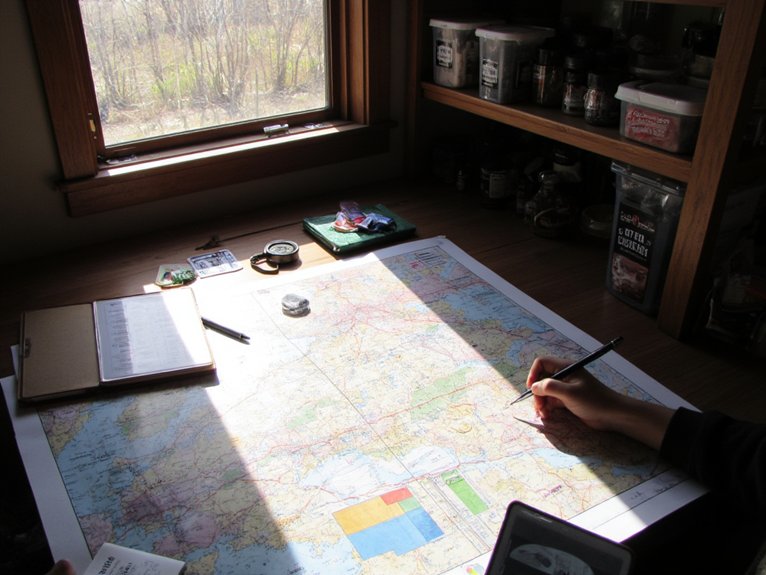
While survivalists often jump straight to stockpiling supplies or practicing emergency drills, establishing a solid threat assessment methodology is your vital first step for effective preparation. It’s the difference between random prepping and strategic readiness.
Start by categorizing threats into probability tiers: likely, possible, and remote. I’ve found that creating a simple matrix (likelihood vs. impact) helps prioritize where to focus your energy. Don’t forget the psychological resilience component—understanding how you’ll mentally respond to various scenarios is just as crucial as physical preparations.
For sensitive information, implement basic cryptographic safeguards to protect your plans. You don’t need military-grade encryption; even simple password protection beats nothing. Remember, threat assessment isn’t a one-time task but an ongoing process that evolves as your circumstances change.
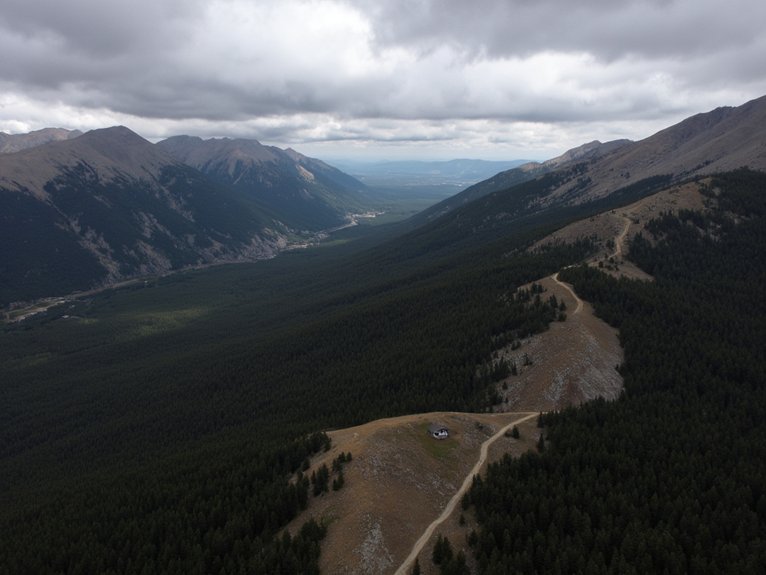
Because your location fundamentally shapes every aspect of your preparedness strategy, conducting a thorough geographic vulnerability assessment is essential. I’ve seen firsthand how urban safety concerns differ dramatically from rural threats, while climate vulnerabilities can blindside even the most thorough preppers.
| Geographic Setting | Primary Threats | Mitigation Priority |
|---|---|---|
| Urban | Civil unrest, infrastructure failure | Evacuation routes |
| Suburban | Supply chain disruption, crime | Community networks |
| Rural | Isolation, limited resources | Self-sufficiency |
| Coastal | Flooding, hurricanes | Elevated structures |
| Mountain | Landslides, wildfire | Fire-resistant design |
Your home’s specific position matters too. Living near a dam? Flood risk skyrockets. Adjacent to industry? Chemical spills become a concern. Remember, the most dangerous threats aren’t always the most obvious ones—they’re the ones you haven’t considered for your particular location.
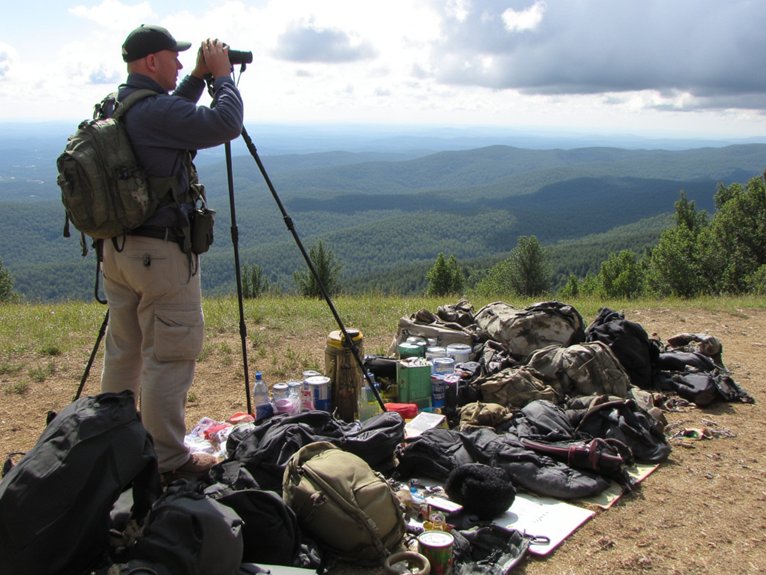
Understanding the timeframe of potential dangers can make all the difference in how you allocate your limited prep resources. I’ve learned through years of preparedness planning that threats don’t all deserve equal urgency. Your emergency communication systems might need immediate attention, while building mental resilience develops over time.
When categorizing threats, consider:
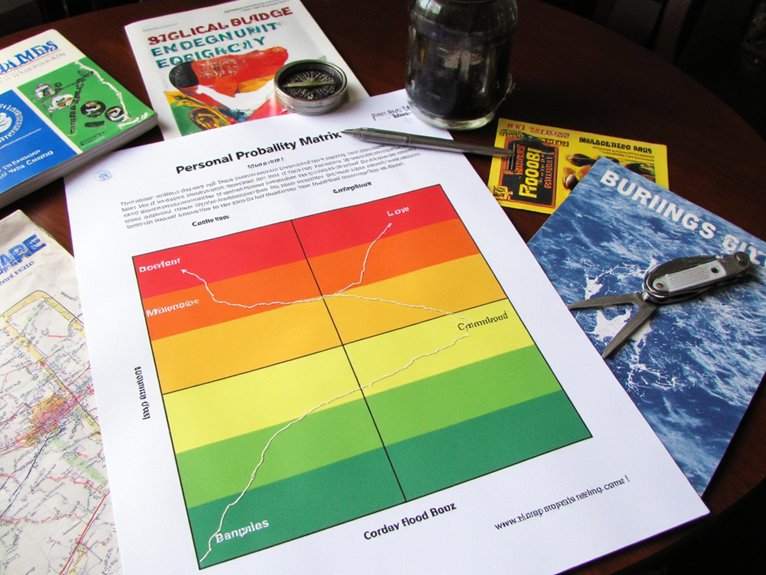
You’ll need a systematic way to weigh both the likelihood and potential impact of various threats in your specific region. Creating a personal probability matrix helps you prioritize preparation efforts by assigning numerical values to each disaster scenario based on historical data, expert forecasts, and your geographical vulnerabilities. This isn’t just about preparing for zombies (though they’d rate high on impact but low on probability); it’s about making smart decisions with limited resources by understanding which threats truly deserve your attention in your particular corner of the world.
While many preppers focus solely on stockpiling supplies, a truly effective preparedness strategy requires balancing the likelihood of various threats against their potential impact on your life. Your risk perception often skews toward dramatic scenarios, but threat prioritization demands honest assessment of both probability and consequence.
Consider these four evaluation points when analyzing threats:
Don’t waste resources preparing for unlikely, low-impact events when more probable threats remain unaddressed. Remember, you’re playing probability chess, not disaster bingo.
Every geographic region presents a unique threat profile that you’ll need to carefully analyze before developing your preparedness strategy. The hurricanes threatening Florida won’t concern Montana residents, who instead face brutal winters and wildfire risks. Your local climate considerations should directly inform your prep priorities—there’s no point stockpiling snowshoes in Phoenix!
Don’t overlook cultural factors when evaluating regional threats. Urban areas may face different social disruption patterns than rural communities during crises. Your community’s response capacity, including emergency services and neighbor relations, considerably impacts your vulnerability. Minneapolis residents might band together during blizzards, while Las Vegas visitors might scatter during water shortages.
Create your personal probability matrix by listing region-specific threats, ranking them by likelihood and impact, then focusing your prep efforts accordingly. Your threat assessment should be as unique as your fingerprint.
Although many preppers invest significant resources protecting against dramatic apocalyptic scenarios, they’re often overlooking more probable threats that deserve their attention. You’ll get more value from your prepping budget by focusing on realistic dangers rather than cinematic disasters.
Common prepper miscalculations include:
You’ll make smarter preparedness decisions when you match your resources to statistically significant threats rather than spreading yourself too thin. A risk-based investment approach—where you allocate more money and time to high-probability/high-impact events—creates a more resilient buffer against genuine dangers. Your preparedness ROI improves dramatically when you analyze local threat data, calculate realistic occurrence rates, and distribute your budget proportionally across your prioritized risk matrix.
When it comes to prepping, distributing your resources strategically isn’t just smart—it’s essential for survival. Your limited budget means you’ll need to make tough choices about where to invest. Climate adaptation should drive these decisions, particularly when considering geographical threats specific to your area.
Here’s how to distribute your prep resources effectively:
Mastering the Probabilistic Investment Framework transforms how you’ll approach prepping by aligning your resources with actual threat levels rather than perceived dangers. Using probability models, you’ll distribute your limited budget where it matters most—for threats that combine likelihood and impact.
Think of it this way: spending $5,000 on radiation gear for a 0.01% annual risk makes less sense than investing that same money in water filtration systems you’ll use regularly. Risk prioritization isn’t just about prepping for doomsday—it’s smart resource management.
Many preppers get this wrong, stockpiling for zombie apocalypses while ignoring common disruptions like extended power outages. Your preparation strategy should resemble a diversified portfolio: heavy investment in high-probability scenarios, with smaller allocations to those low-probability, high-impact events that keep you up at night.
While many preppers focus solely on accumulating gear, a Preparedness ROI Analysis reveals which investments genuinely protect your family and which simply drain your wallet. I’ve analyzed hundreds of survival scenarios and found that smart resource allocation consistently outperforms panic-buying expensive survival gear.
To maximize your preparedness ROI:
Remember: the best preparation balances tangible resources with knowledge and relationships.
As evidence continues to shape our understanding of potential threats, you’ll find that adopting a systematic approach to threat assessment dramatically improves your preparedness outcomes. Start by quantifying risks using reliable data sources rather than social media hysteria. Climate change impacts—like intensifying storm systems and shifting agricultural zones—represent tangible, measurable threats that should inform your planning. Similarly, technological disruption, from power grid vulnerabilities to AI-driven job displacement, demands rational evaluation.
Remember: your brain evolved to overestimate immediate dangers while undervaluing slow-moving threats. Combat this bias by creating a threat matrix that scores risks on probability, impact, and timeframe. When you’re drowning in doomsday scenarios, this evidence-based framework will be your life preserver—separating legitimate concerns from apocalyptic noise.
Even the most carefully constructed threat assessment becomes dangerously obsolete without regular updates. Your psychological resilience depends on maintaining a realistic view of evolving dangers rather than clinging to outdated fears. I’ve found that quarterly reassessments strike the perfect balance between vigilance and obsession.
Implement these four reassessment triggers:
Community networking provides invaluable intelligence you’d miss alone. Trading observations with trusted neighbors often reveals blind spots in your analysis. Remember, the prepper who adapts fastest isn’t the one who predicted everything correctly—it’s the one who recognized changing conditions first.